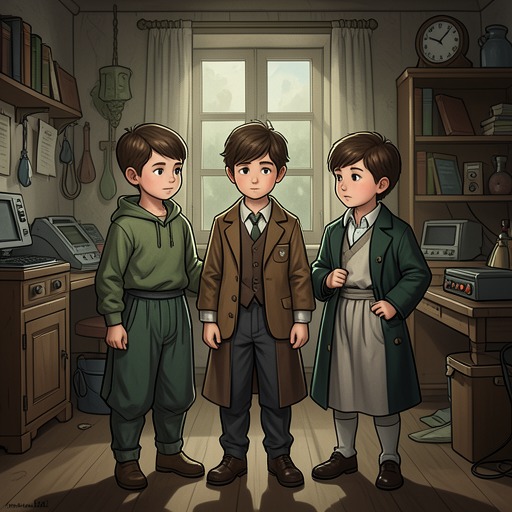
Kathy stops Tommy’s outburst on the sports field
Never Let Me GoKathy stops Tommy’s outburst on the sports field by approaching him when his classmates have withdrawn to watch and laugh. Her intervention does not begin as a grand gesture: she moves toward him despite Ruth’s warning, tries to protect a shirt he cares about, and brings his attention back to the immediate world around him. The scene turns a spectacle of exclusion into a brief, awkward encounter in which Tommy becomes aware of himself again.
The outburst and its audience
Tommy’s rage follows a team-picking episode in which he is left until the other boys have chosen, while the girls watch and anticipate his reaction. When he is left alone, he pursues the departing boys for a few strides, then stops and screams a nonsensical jumble of insults. His anger has an audience even after its original targets disappear: the boys run toward the South Playing Field, while the others first try to ignore the noise and later return to the windows to watch.
The watching is not innocent. The group has already treated Tommy’s exclusion as entertainment, and its members now explain his mistreatment by saying that he is lazy and makes no effort to be creative. They had not all helped devise this particular provocation, but they have taken what Kathy recalls as ringside seats. Their guilt remains entangled with the justifications they trade among themselves; rather than fetch a guardian, they continue watching until Ruth says it is time to return to the main house. Against this collective distance, Kathy’s decision to cross the field is a small but decisive break with the role of spectator.
Kathy approaches Tommy
As the others walk along the edge of the field, Kathy drifts toward Tommy, even after Ruth urgently whispers for her to come back. Tommy does not seem to recognize her at first. He continues raging as though she has entered the middle of a performance, unaware of her attempt to speak to him. Kathy addresses a practical concern rather than the humiliation that has set off the episode: “Tommy, your nice shirt. You’ll get it all messed up,” she tells him, but he gives no sign that he has heard.
Kathy then reaches for his arm. Tommy’s flailing movement knocks her hand aside and strikes her face. The blow is not intentional in her judgment, and it does not hurt; its importance is that it breaks through his absorption. He looks at Kathy, the watching girls, and himself, registering that he is in the field and behaving as he is. The scene pivots not through a reasoned appeal or an apology, but through an accidental contact that makes the raging boy newly conscious of his surroundings.
The shirt as a point of return
Once Tommy notices Kathy, she repeats that mud is all over his shirt. He answers, “So what?” but looks down and sees the brown specks; he almost cries out in alarm. Kathy understands that the shirt matters to him, and Tommy is surprised that she knows about his attachment to it. Her practical reassurance—that the mud will come off and that he can take it to Miss Jody if he cannot clean it himself—offers a manageable problem in place of the diffuse fury and public shame.
The shirt does not resolve the cause of Tommy’s rage, and Kathy does not pretend that it does. Instead, attention to the garment supplies a narrow route back from uncontrolled performance to ordinary exchange. Tommy examines the mud, then says, “It’s nothing to do with you anyway.” He seems almost immediately to regret the rebuff and looks sheepish, as if expecting comfort. Kathy, conscious of the girls watching and of possible observers at the main house, has had enough and turns away. The return to conversation is fragile: Tommy’s embarrassment and her withdrawal remain visible alongside the small success of having redirected his attention.
Aftermath and significance
Ruth puts an arm around Kathy’s shoulders as they walk away, says that Kathy at least got Tommy to pipe down, and asks whether she is all right. The gesture draws Kathy back into the group, but the exchange also marks her intervention as something the others have noticed. She has crossed the distance they maintained, though she does not stay to console Tommy once he has become aware of himself and his shirt.
Looking back, Kathy connects her approach to a phase in which she compulsively set herself challenges; she had more or less forgotten the incident until Tommy stopped her a few days later. That retrospective qualification keeps the act from becoming a simple story of deliberate rescue. In the moment, however, she does choose to approach despite Ruth’s warning, and her attention to a detail Tommy values reaches him where the group’s laughter and moral explanations do not. The scene thus sets apart two forms of response to his exclusion: the classmates turn his rage into a spectacle and rationalize the teasing, while Kathy’s improvised concern interrupts the spectacle without erasing either its cause or the embarrassment left behind.